
December 11, 2024
Background
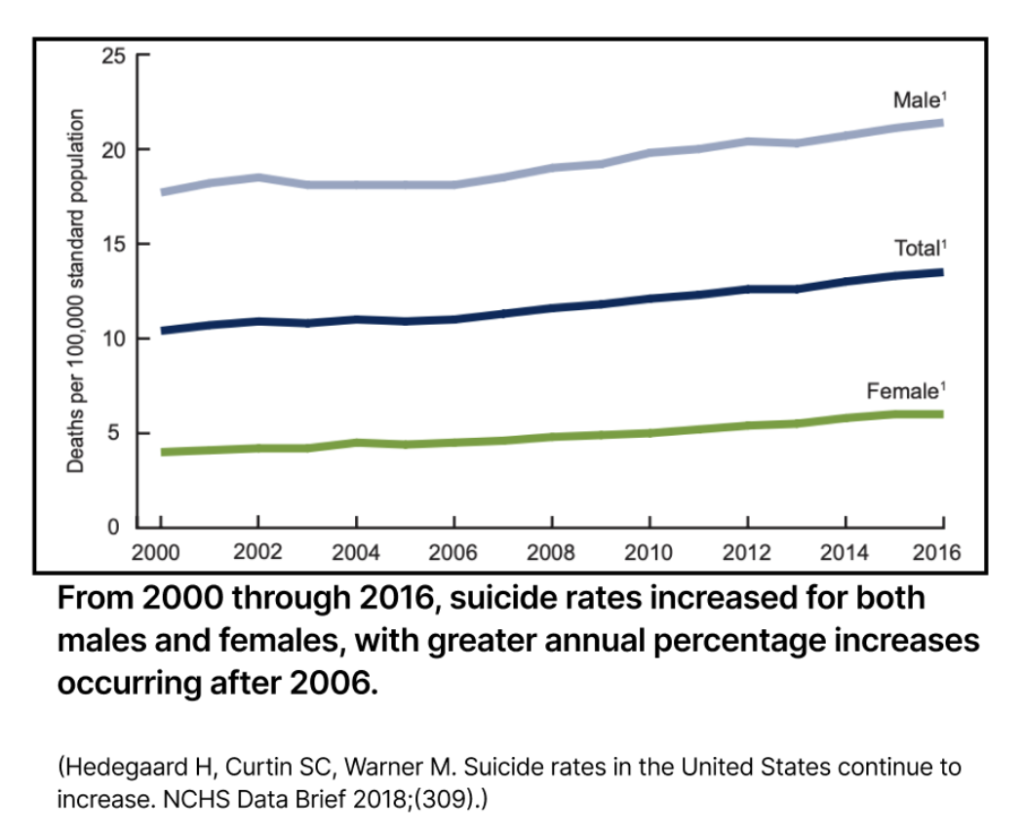
Having worked in the field of clinical psychology in the past, I have always been interested in conducting research related to mental health. One particular study that highlighted the rising suicide rates across the United States over the years sparked my initial interest in this topic.
The study pointed out that from 2000 through 2016, suicide rates increased for both males and females, with greater annual percentage increases occurring after 2006. It also categorized these trends by gender, providing a clear breakdown of the rising rates. Building on this, I conducted further analysis to explore additional patterns and insights beyond the gender-based trends.
I created a dashboard to visualize the changes in suicide rates across U.S. states. Each point on the dashboard represents the suicide rate for a specific state in a given year. Upon closer inspection, it becomes evident that in many states, the size of the points gradually increases over time, reflecting the rising suicide rates as the years progress.
To highlight this trend, I also created a Tableau visualization. By selecting all states, the visualization effectively represents the nationwide changes. It clearly shows a consistent upward trend in suicide rates over the years.
The upward trend in suicide rates is certainly a matter of concern. However, since we are in New York, I paid particular attention to the suicide rate trends in this state. Interestingly, I found that New York’s suicide rates are significantly lower compared to other states.

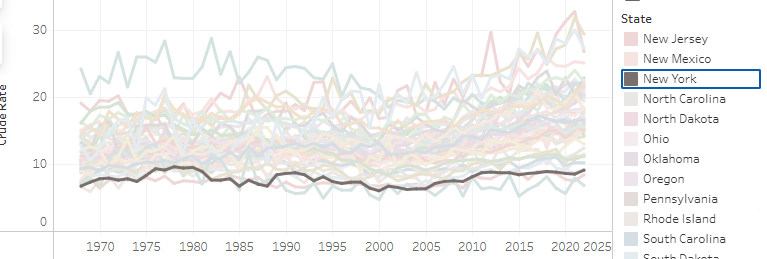
As a major metropolitan area, New York—particularly New York City—has an exceptionally high population density. Yet, despite the large population, it has managed to maintain a relatively low suicide rate. I believe that the abundance of mental health resources in the city plays a crucial role in this outcome.
This observation brings us back to the core focus of this study: understanding the distribution of mental health resources in New York City.
Specifically, I aim to explore whether the city’s mental health resources are equitably distributed and how we can identify areas with high demand. By incorporating key socioeconomic factors, this research seeks to provide insights into potential gaps in resource accessibility and inform future planning and policy decisions.